


AI Tools for Marketing Strategies Marketers Actually Trust
AI tools for marketing are no longer optional, they set the pace. Teams that ship more tests, more content variations, and more iterations per week win distribution and learn faster. Speed turns into signal, and signal turns into better creative, better targeting, and better budget decisions.
The shift is practical, not ideological. Marketers now use AI to draft and repurpose content, cluster keywords, generate ad variations, summarize research, and spot performance anomalies. Used well, AI removes busywork so people can focus on positioning, offers, and measurement. Used poorly, it creates noise, brand risk, and reports nobody trusts.
Why AI Adoption Became Table Stakes
AI adoption became table stakes because cost and competition pressure every channel. Efficiency matters because attention is scarce, and buyers compare options faster than your team can produce new assets without help.
- Cycle time: go from idea to asset to test in days, not weeks.
- Consistency: keep brand rules in prompts, templates, and workflows.
- Decision quality: turn messy data into clear next actions.
If you feel tool overload, you are not behind, you are normal. A curated directory like Sales & Marketing AI Tools helps you start with the job to be done, then shortlist tools that fit the workflow.
What Actually Counts as “AI Tools for Marketing” in 2026?
If AI is now the baseline, marketers need a clean definition. In 2026, an “AI tool for marketing” counts when it generates, predicts, or decides using machine learning models, not when it only triggers rules and templates.
What Makes a Marketing Tool “AI” (Not Just Automated)
A true AI marketing tool uses a model to create new output or make a probabilistic judgment from data. That usually shows up in three forms: assistants, agents, and prediction.
AI Assistants (Copilots) That Improve Your Work
Assistants help a human move faster, but you still drive. Examples include ChatGPT (OpenAI) for drafting and ideation, and Canva for AI assisted creative production. These tools count because they generate net new text, images, or variations, then you select and refine.
AI Agents That Execute Multi Step Tasks
Agents do more than answer prompts, they take actions across tools after you set goals and guardrails. For marketing, that can mean: pulling campaign data, proposing changes, creating assets, and opening tickets for review. Agent behavior is imperfect, so the “counts as AI” test is simple: does it plan and act across steps, not just run a single command?
Predictive And Decision Systems That Change Outcomes
Prediction matters most when money is on the line. Examples include Google Ads Smart Bidding (automated bidding powered by machine learning) and Salesforce Einstein (AI features for CRM). These count because they forecast or optimize based on patterns in performance and customer data.
What Does Not Count (Or Counts Less Than People Think)
- Rule based automation like “if lead score over X, send email Y.” Useful, but not AI.
- Generic “AI inside” claims with no explanation of what the model does, what it learns from, or how you control it.
- One click generators that produce content but cannot adapt to brand rules, audience signals, or performance data.
If you want to avoid hype, start by naming the job to be done, then shortlist tools by that job. PerfectStack.ai helps with this by organizing tools by use case so you can spot which products deliver real AI workflows versus simple automation.
The 6 AI Tool Categories That Move Revenue
If tool overload is the problem, categories are the fix. A useful AI tool stack starts with which revenue lever you need to move, then you pick one tool that improves throughput or decisions in that lane.
1) Content Creation And Repurposing
This category helps you publish more, with fewer bottlenecks. Use it for briefs, outlines, first drafts, rewrites, and content repurposing across formats.
- Output it improves: pages published, time to first draft, creative variations
- Examples: ChatGPT, Jasper, Adobe Firefly
2) SEO Research And AI Search Visibility
SEO tools now mix classic keyword work with AI assisted content planning and technical checks. The goal stays simple, earn qualified clicks you do not pay for, and get referenced in AI answers.
- Output it improves: topic coverage, rankings, crawl health, content briefs
- Examples: Ahrefs, Semrush, Surfer SEO
3) Social Planning, Creation, And Community
Social AI supports ideation, post versions, scheduling, and response triage. It works best when you keep a tight brand voice and approval rules.
- Output it improves: posting cadence, response time, creative testing
- Examples: Hootsuite, Buffer, Sprout Social
4) Paid Ads And Creative Optimization
Ad platforms already use machine learning, but AI tools help you feed the system better inputs. Focus on more testable variations and faster learning cycles.
- Output it improves: creative volume, speed of iteration, CPA and ROAS stability
- Examples: Google Ads, Meta Ads Manager, Optmyzr
5) Email, CRM, And Lifecycle Automation
This is where AI creates compounding returns, because it touches retention. Use it for segmentation, personalized content, and triggered journeys.
- Output it improves: conversions, retention, lead to customer velocity
- Examples: HubSpot, Salesforce, Klaviyo
6) Analytics, Attribution, And Decision Support
AI in analytics should answer one question, what should we do next. Look for anomaly detection, forecasting, and plain language reporting on clean data.
- Output it improves: budget allocation, forecasting, experiment analysis
- Examples: Google Analytics, Mixpanel, Amplitude
If you map your needs to one category first, PerfectStack.ai makes shortlisting faster because you can browse tools by the job to be done, not by hype.
How to Choose the Right Stack Without Tool Overwhelm
Tool overwhelm usually starts with a false goal: “find the best AI tool.” A better goal is: pick one workflow, then pick tools that support it. If a tool does not cut cycle time, reduce errors, or improve revenue decisions, it is noise.
How to Choose the Right Stack Without Tool Overwhelm
Start with a single, testable use case. Use case first beats feature lists because AI features change monthly and your workflow stays.
- Define the job: “Turn one webinar into 10 approved assets,” or “Find 20 high intent keywords and ship 5 pages.”
- Define success: time saved per week, cost per lead, conversion rate, content velocity, or pipeline influenced.
- Set guardrails: what the tool can publish automatically, and what needs human approval.
Check Integrations Before You Fall in Love
Most “great” tools fail in week two because nobody connects them. Integration fit decides adoption. Confirm the tool works with what you already run, like Google Analytics, Google Ads, HubSpot, Salesforce, WordPress, or Slack. Also confirm export options (CSV, API, webhooks) so you can leave later.
Get Clear on Data and Privacy
Ask one direct question: What data does the model store, and who can access it? If you handle customer data, check the vendor’s security and privacy pages, and look for basics like SSO, SOC 2 reports, and data retention controls. If you need a baseline, NIST’s AI Risk Management Framework helps teams structure the conversation: https://www.nist.gov/itl/ai-risk-management-framework.
Run a 14 Day ROI Trial, Not an Endless Pilot
A real trial has a start and a stop. Measure time and output, not vibes. Track: hours saved, assets shipped, lift in CTR, lift in CVR, or reduction in CPA. Keep the scope narrow and compare to a pre AI baseline.
Match Tools to Team Fit
Choose the simplest tool your team will actually use. If your team lives in spreadsheets, pick tools with strong exports. If your team lives in a CRM, prioritize native integrations. If you want faster shortlists by job to be done, PerfectStack.ai helps you filter options without chasing every launch.
PerfectStack.ai: A Faster Way to Find Vetted AI Tools
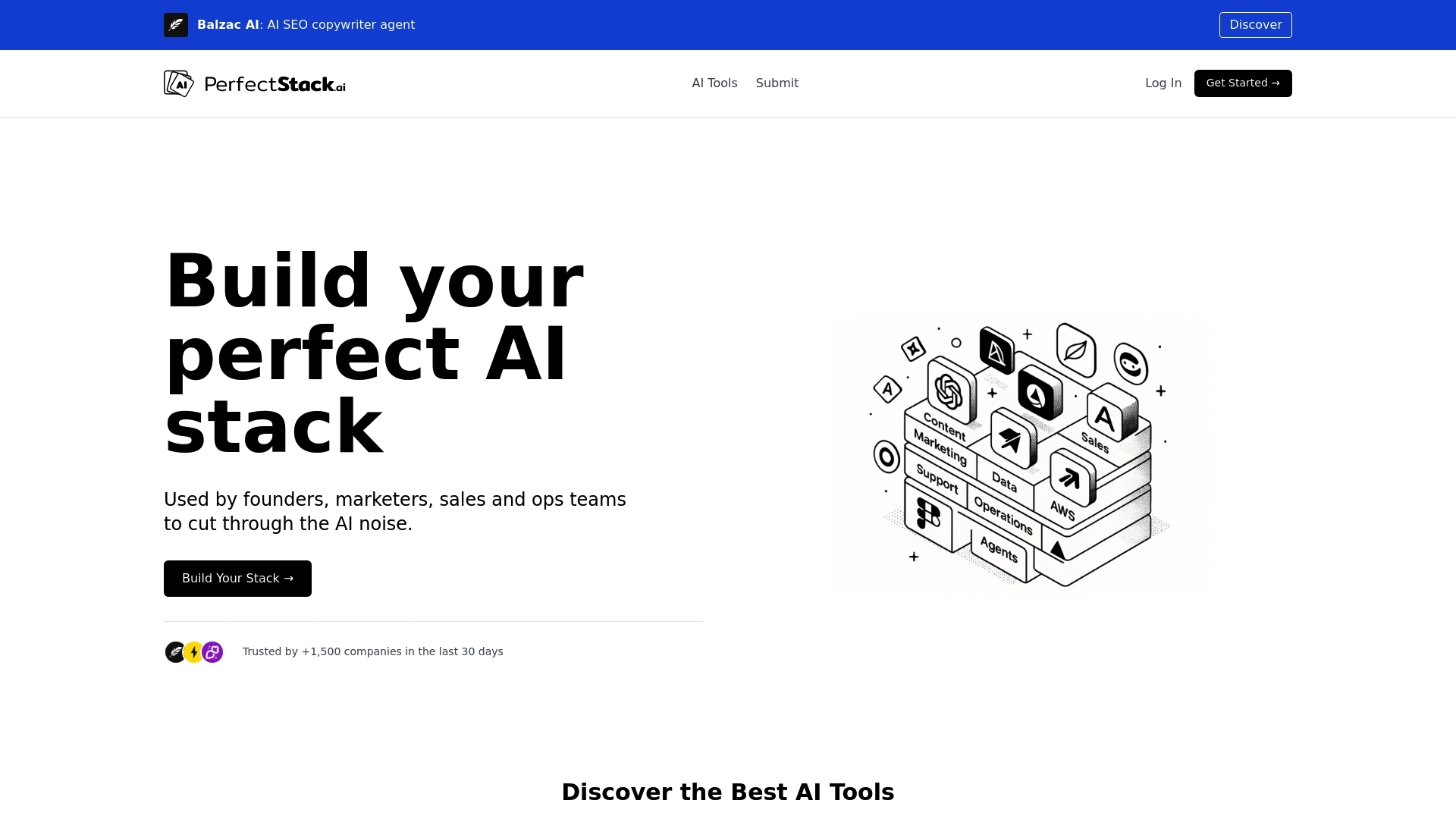
Most marketers do not fail because they lack tools, they fail because they pick tools before they pick a workflow. That creates a stack that looks modern but does not ship work faster, measure better, or reduce risk. A curated directory helps only if it sorts options by what you need to do, not by what is trending on a feed.
PerfectStack.ai: A Faster Way to Find Vetted AI Tools
PerfectStack.ai helps marketers shortlist AI tools by job to be done, so you can move from browsing to testing in one session. Instead of reading scattered lists, you search and filter a structured catalog of 3,000 plus tools, organized by category and task, with tool pages that include plain descriptions, screenshots, and direct links.
What “Vetted” Means in Practice
Vetted does not mean perfect. It means the directory favors clear, usable information over vague claims. The editorial review of user submitted tools also reduces obvious spam and duplicates, which matters when you want a short list you can actually evaluate.
How Marketers Use PerfectStack.ai Without Wasting More Time
The fastest way to use a tool directory is to treat it like a shortlisting system, not entertainment.
- Start with the deliverable: for example, “turn one webinar into 12 social clips” or “build SEO briefs for one cluster.”
- Choose one category: content, SEO, social, ads, email or CRM, or analytics.
- Open 3 to 5 tool pages: check if the tool supports your data inputs, export formats, and collaboration needs.
- Pick one paid pilot: run one workflow for two weeks, compare time saved and output quality.
What This Solves for Real Teams
- Tool overwhelm: fewer tabs, fewer “top 50” lists.
- Evaluation gaps: consistent structure makes comparisons faster.
- FOMO: updates help you spot new tools without chasing every launch.
Best AI Tools for Digital Marketing 2026: What’s Rising Now
In 2026, the best AI tools for digital marketing share one trait: they reduce cycle time without breaking trust. Marketers now buy for reliability, traceability, and workflow fit, not for “more prompts.” Four trends shape what rises and what gets cut from budgets.
Multimodal Creation Becomes The Baseline
Multimodal tools matter because audiences consume mixed formats, and teams need one source of truth for brand visuals and copy. You see more stacks that combine writing, images, and video into a single workflow, with human approvals.
- Core tools: Adobe Firefly (in Creative Cloud), Canva, ChatGPT.
- What to look for: brand kits, style references, licensing clarity, version control.
AI Search And GEO Drive Content Decisions
AI search changes discovery because people ask engines for answers, not links. GEO (Generative Engine Optimization) focuses on being cited in AI responses by publishing clear definitions, structured lists, and verifiable claims. Classic SEO still matters, but teams now prioritize topical coverage and quotable formatting.
- Tools used alongside editorial work: Ahrefs, Semrush, Surfer SEO.
- Helpful reference: Google’s Search Quality Rater Guidelines explain what quality signals look like: https://developers.google.com/search/blog/2022/07/search-quality-rater-guidelines.
Agentic Workflows Move From Demos To Production
Agentic workflows win when they execute repeatable ops tasks with guardrails. The best setups keep agents on draft, summarize, and route, then require human approval for publishing and spend changes.
- Common building blocks: HubSpot AI features, Salesforce Einstein, Zapier (automation plus AI steps).
Measurement You Can Trust Becomes A Buying Requirement
Marketers reject black box reporting. They want explainable numbers, clean events, and shared definitions across teams. Tools that pair analysis with action, like Google Analytics 4, Mixpanel, and Amplitude, win when teams also enforce naming conventions and governance. If you need a fast shortlist by job to be done, PerfectStack.ai helps you compare tools by workflow, not by noise.
Conclusion: Pick One Workflow, Then Let Results Pick the Tools
You do not need another list of tools, you need one workflow you can measure. Tool FOMO fades fast when you tie AI to a concrete outcome: more qualified traffic, more pipeline, lower CPA, faster production, or clearer reporting. If a tool does not move one of those, it does not belong in your stack.
Here is the decisive takeaway: results pick the tools, not the other way around. Start narrow, prove value, then expand. This keeps quality high, reduces brand risk, and stops your team from spending weeks “evaluating” instead of shipping.
A Simple 30 Day Plan You Can Actually Run
Pick one category from this article (content, SEO, social, ads, email or CRM, analytics) and commit to a 30 day test with a baseline. Keep humans in the loop for anything public facing or revenue critical.
- Days 1 to 3: Write a one sentence job statement and a success metric (example: “Publish 4 SEO pages this month,” “Cut reporting time from 3 hours to 45 minutes”).
- Days 4 to 7: Shortlist 3 tools, check integrations and data controls, then pick 1 to pilot.
- Days 8 to 21: Run the workflow every week, store prompts, templates, and brand rules in one shared doc.
- Days 22 to 30: Compare against baseline, keep, replace, or remove the tool, then document what changed.
What To Measure So You Trust the Outcome
- Throughput: assets shipped per week, tests launched, pages published.
- Efficiency: hours saved, handoffs removed, fewer revisions.
- Performance: CTR, CVR, CPA, retention, pipeline influenced (use the metric your team already reports).
If you want to cut the shortlist time, use PerfectStack.ai AI Tools to filter by the job to be done, then validate with a tight trial. You will build a stack you can defend because you measured it.